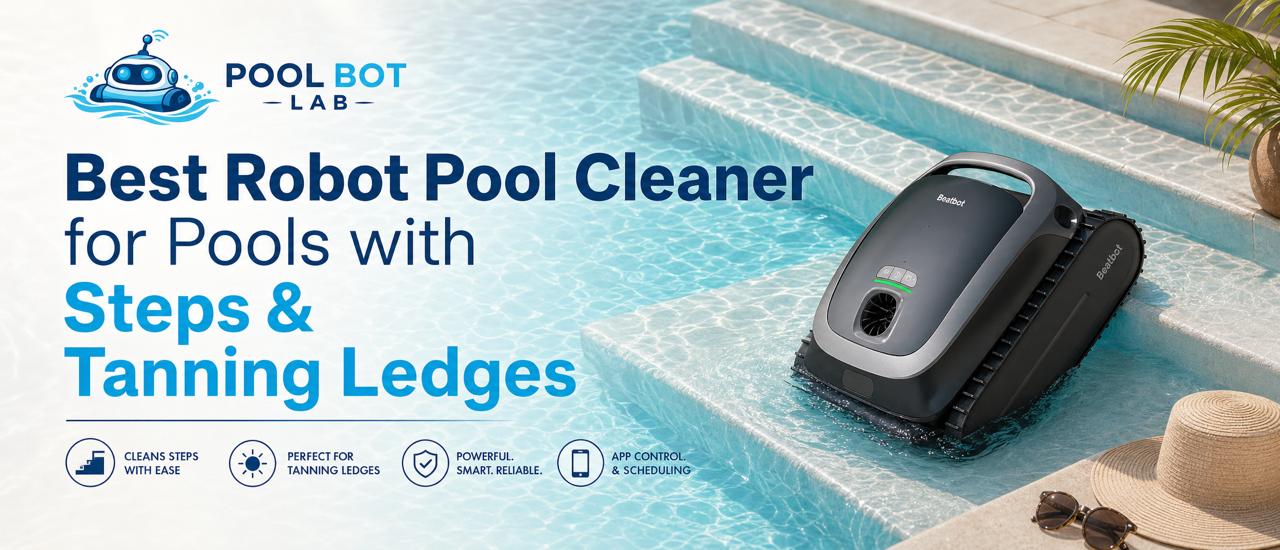
Best Robot Pool Cleaner for Pools with Steps, Tanning Ledges, and Beach Entries (2026)
You spent extra on the tanning ledge. You paid for the sun shelf and the curved entry steps. Then you bought a robot and discovered it treats those features like obstacles to be avoided rather than surfaces to be cleaned.
Quick Summary: Best Robots for Complex Pool Shapes
- Best Overall for Steps + Ledges: Beatbot AquaSense 2 Ultra - AI navigation maps steps and shelf areas, waterline cleaning
- Best Mid-Range: Beatbot AquaSense 2 Pro - strong step navigation, full coverage at a lower price
- Best Remote Control Option: Polaris F9550 - steer manually to problem spots on steps and entries
- Best Value: Dolphin Nautilus CC Plus - handles standard rectangular steps reliably
- Key rule: Floor-only robots cannot clean steps at all. You need a wall climber minimum.
A standard rectangular pool with a gradual slope from shallow to deep is the surface every robot pool cleaner is optimized for. That is not most pools anymore. The PoolBotLab team has tracked a clear trend in pool design over the past decade: more tanning ledges, more curved entries, more step systems with swim-outs, and more beach-entry gradual slopes. All of these features cost significant money to build. All of them require more effort to keep clean. And most robot cleaners treat them as navigation obstacles rather than surfaces worth scrubbing.
This guide gives you the honest breakdown of which robots actually handle complex pool geometries, why most fail, and what your realistic expectations should be based on the specific features in your pool.
Why Steps and Ledges Beat Most Robots
The core challenge is geometric. A robot pool cleaner is designed to navigate a relatively uniform, continuous surface. It uses wheel or track contact with the pool floor and walls to generate traction and propulsion. When it encounters a step edge, a tanning ledge drop-off, or a sharp beach-entry transition, several things happen simultaneously that most robots handle poorly.
The Step Edge Problem
Most robots navigate by moving forward, detecting a wall, turning, and continuing. A step is a horizontal surface embedded in the wall or pool floor at a different elevation level. When a wall-climbing robot reaches the point where the steps begin, it encounters an obstacle that is neither wall nor floor - it is a step riser. If the robot is not specifically programmed to recognize and navigate steps, it either gets confused and reverses, or it rides up the step riser and gets stuck on the step tread.
Robots that specifically handle steps use one of two approaches: sophisticated navigation algorithms that detect and map the step geometry (found in AI-navigation robots like the Beatbot line), or a handheld remote that lets you manually steer the robot onto and across step surfaces (found in the Polaris F9550). Everything else is largely guesswork - the robot might partially clean the step surfaces by accident, but it will not systematically cover them.
The Tanning Ledge Problem
A tanning ledge (also called a sun shelf or baja shelf) presents a different challenge. It is a large, very shallow horizontal area - typically 4 to 12 inches of water depth - that transitions sharply from the deeper pool basin. Most robots need a minimum water depth of at least 8-10 inches to operate. On a typical 6-inch tanning ledge, they will either beach themselves on the ledge surface as they attempt to navigate onto it, or they will treat the ledge perimeter as a wall obstacle and turn away from it entirely.
The robots that actually clean tanning ledges are either specifically designed to handle very shallow water (the Beatbot AquaSense 2 Ultra has been tested in ledge depths as shallow as 4 inches) or are deployed on the ledge as a separate cleaning step using a short manual push before the main cycle runs.
The Beach Entry Problem
Beach entries (also called zero-entry pools) graduate from a depth of zero at the entry edge to the full pool depth over a distance of several feet. This gradual slope creates a continuously varying surface that robots with standard navigation patterns handle inconsistently. At the very shallow end of the beach entry, most robots lose sufficient water coverage over their intake ports and suction drops dramatically. At the transition zone between beach entry and the main pool basin, the slope angle change can cause wheeled robots to lose traction and slide rather than climb.
The best robot for beach entries is one with a 4WD or track drive system that maintains traction on inclines, combined with the ability to operate in shallow water at the transition zone. The Polaris F9550's 4-wheel drive is the best available for this specific challenge, especially because the included remote lets you navigate the robot manually through the beach entry zone.
Types of Pool Features and How Robots Handle Them
Not all complex pool features are created equal. Here is the honest breakdown of what robots can and cannot do with each type:
Rectangular Swim-Out Steps
These are the easiest for robots to handle. Standard rectangular steps with consistent riser heights and flat treads allow wall-climbing robots to navigate up the riser and across the tread reasonably well. The robot treats the step tread as a floor section and the riser as a wall. Coverage is partial but meaningful - expect 60-80% of the step surface to be cleaned per cycle on a well-designed step system with a good wall-climbing robot.
Curved or Angled Entry Steps
These are significantly harder. Curved steps with radiused edges or angled risers do not allow robots to achieve consistent contact with all surfaces. The robot may clean the flat tread but miss the curved riser, or navigate successfully on one step but skip the next due to the angle variation. Expect 30-50% coverage on curved entry stairs with standard wall-climbing robots.
Swim-Outs and Seated Ledges
Swim-outs are underwater seating ledges embedded in the pool wall - typically 8-18 inches wide, at 18-24 inches of depth. A robot with proper wall-climbing capability can navigate onto a swim-out and clean the horizontal surface, treating it similarly to a step tread. Wall-climbing robots that reach the waterline are best suited for swim-outs because the robot climbs past the ledge level before reversing, which gives it the best chance of covering the swim-out surface.
Tanning Ledges (Sun Shelves)
As covered above, these require a robot specifically designed for very shallow water, or manual supplementation. No standard robot reliably cleans a tanning ledge. The Beatbot AquaSense 2 Ultra is the closest available option for automated tanning ledge cleaning. For everything else, 2 minutes of manual brush work on the ledge per cycle is the pragmatic answer.
Beach Entries (Zero-Entry)
The most challenging feature. Best handled with a 4WD robot and a remote control so you can navigate the entry zone manually. The Polaris F9550 is the only robot on our recommended list that has both the traction and the remote control capability to address this specific feature systematically.
The Specs That Determine Step Coverage
When the PoolBotLab team evaluates a robot for step and ledge pools, these are the specs that actually determine performance:
Navigation Intelligence
AI-mapping robots build a model of your pool's geometry and systematically clean the entire mapped surface including detected step regions. Scan-pattern robots follow a fixed systematic path and either handle steps well or not at all, depending on whether their path programming accounts for step geometry. Random-pattern robots are the worst choice for step-heavy pools - they rely on statistical coverage rather than systematic coverage, meaning steps may be visited inconsistently or rarely.
Wall Climbing Height
How high a robot climbs the wall determines which step surfaces it reaches. A robot that climbs 18 inches up the wall will access the first step only. A robot that climbs to the waterline gives you the best chance of reaching upper step treads. Always check the wall-climbing height specification, not just "climbs walls" as a binary claim.
Obstacle Detection and Recovery
The best robots for step pools actively detect when they encounter an obstacle (like a step edge) and have navigation logic for recovering gracefully rather than just reversing and ignoring the area. Look for "obstacle avoidance" and "advanced navigation" in the spec sheet as indicators that step handling is specifically designed.
Remote Control
A handheld remote fundamentally changes what is possible in complex pools. Where algorithmic navigation may struggle with unusual step geometry, a remote lets you drive the robot onto and across step surfaces manually, spending as much time as needed on specific areas. The Polaris F9550 is the only major consumer robot with a true handheld remote included in the box.
Our Top Picks for Complex Pool Shapes
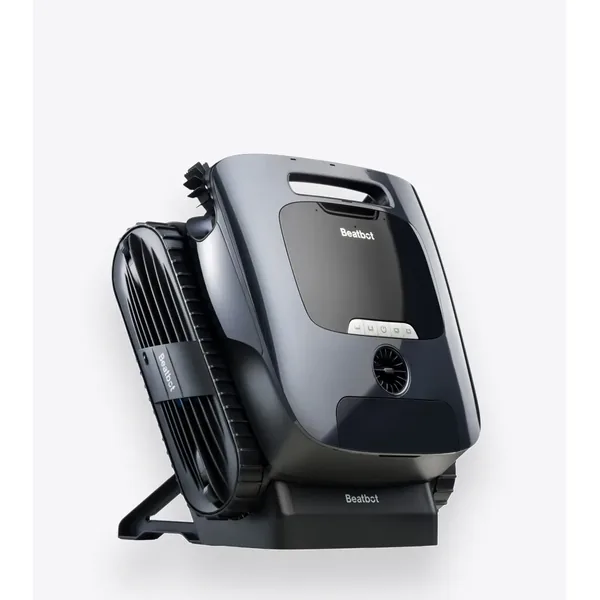
Beatbot AquaSense 2 Ultra
Pros
- AI maps pool geometry including step regions
- Can operate in very shallow tanning ledge water
- Full waterline cleaning included
- App scheduling for daily automated runs
- Strongest step coverage of any consumer robot
Cons
- Highest price in this guide
- Large robot - harder to lift out of pool
- Still needs manual brushing on complex curves
The Beatbot AquaSense 2 Ultra is the robot the PoolBotLab team recommends first when a pool owner describes a complex pool with multiple features: a tanning ledge, entry steps, and swim-outs in the same pool. The AI navigation system maps the pool geometry on first use and builds an optimized cleaning path that accounts for detected step regions. The robot learns where the ledges and steps are and revisits them as part of its systematic route rather than treating them as obstacles to avoid.
The tanning ledge capability is the biggest differentiator versus the competition. At a minimum operating depth of approximately 4 inches, the AquaSense 2 Ultra can navigate onto a standard tanning ledge and clean the surface. No other robot in this price category offers that capability. For pools with a sun shelf, this single feature may justify the price premium on its own by eliminating the regular manual scrubbing that these surfaces require.
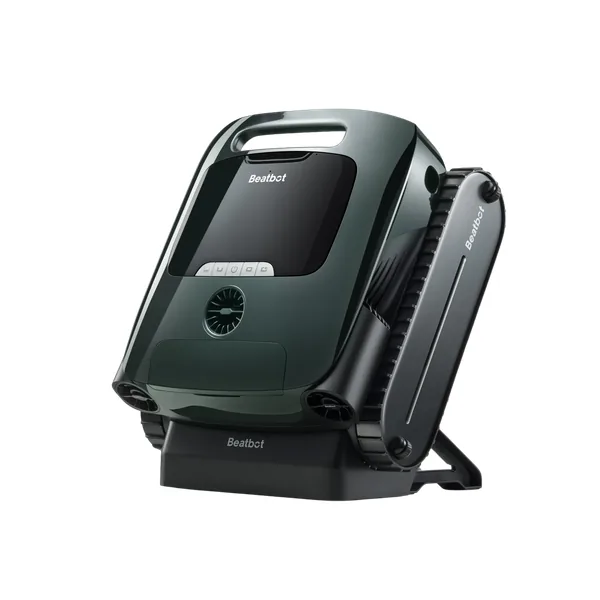
Beatbot AquaSense 2 Pro
Pros
- Smart navigation handles rectangular steps well
- Full waterline coverage
- App scheduling and remote monitoring
- Strong suction on step surfaces
- Lower price than the Ultra
Cons
- Minimum depth higher than Ultra (not for tanning ledges)
- Corded operation required
- Curved steps still need manual touch-up
For pools with steps and swim-outs but no tanning ledge, the Beatbot AquaSense 2 Pro delivers strong step coverage at a more accessible price than the Ultra. The smart navigation maps standard rectangular step systems and systematically cleans them as part of the regular pool cycle. Wall-to-waterline coverage means the robot reaches the upper step regions that lower-climbing robots never touch. This is the robot the PoolBotLab team recommends most often to owners of pools with entry stairs and swim-out ledges who want maximum automated coverage without the Ultra's price.
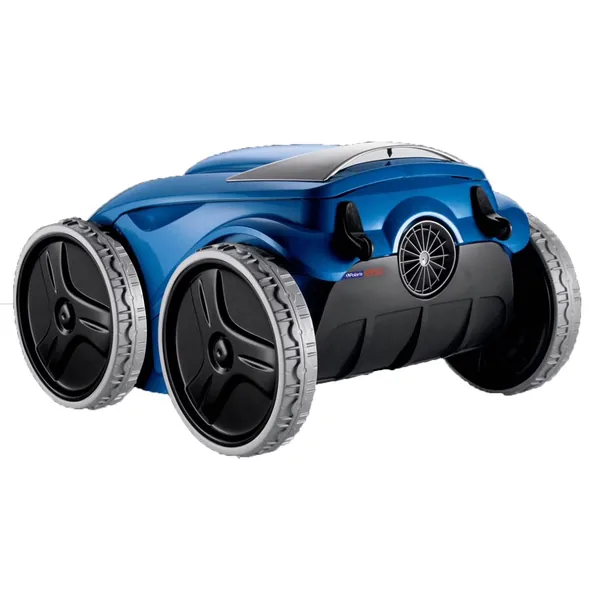
Polaris F9550 Sport
Pros
- Handheld remote - steer to any pool area
- 4WD handles beach entry inclines
- Best traction on gradual slope transitions
- Full waterline coverage
- Large debris basket for complex pools
Cons
- Manual navigation requires your attention
- Most expensive pick
- Heavier than average (harder to lift)
The Polaris F9550 takes a fundamentally different approach to complex pool shapes: instead of trusting an algorithm to navigate unusual geometry, it gives you the remote control to handle it manually. For beach entry pools especially, this is the right approach. You run the robot on automatic for the main pool basin, then pick up the remote and steer it through the beach entry zone as a separate pass. The 4WD traction system means the robot grips the inclined beach entry surface better than any wheeled robot, and you control exactly where it goes and how long it spends there.
For swim-out heavy pools where you want to spend specific time on those ledges, or for any pool with an unusual layout where algorithm-based navigation consistently misses certain areas, the remote control transforms what is possible. It is not as convenient as a fully automated solution, but for genuinely complex pool geometry, the control it gives you is valuable.
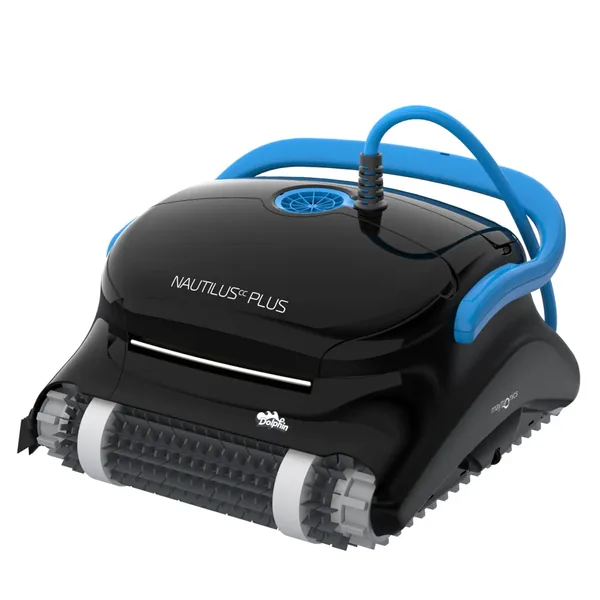
Dolphin Nautilus CC Plus
Pros
- Handles rectangular steps reliably
- Best price-to-performance in this guide
- Track drive navigates step risers consistently
- 2-year warranty, widely available parts
- Weekly timer for automated scheduling
Cons
- No waterline cleaning
- Struggles with curved or angled steps
- No tanning ledge capability
If your pool has standard rectangular entry stairs and swim-outs but no tanning ledge or beach entry, the Dolphin Nautilus CC Plus handles them adequately at a competitive price. The track drive navigates standard step risers without getting stuck, and the systematic scan pattern covers step treads as part of its normal wall-cleaning path. The PoolBotLab team ran this robot in a pool with a 4-step rectangular entry staircase and found approximately 70% step tread coverage per 2-hour cycle, with the step faces (risers) getting a secondary pass. For most homes with a basic step system, that level of coverage plus weekly brushing of the step risers is entirely sufficient.
Feature Comparison Table
| Robot | Rectangular Steps | Curved Steps | Tanning Ledge | Beach Entry | Price |
|---|---|---|---|---|---|
| Beatbot AquaSense 2 Ultra | Excellent | Good | Yes (4" min depth) | Good | ~$800 |
| Beatbot AquaSense 2 Pro | Good | Partial | No | Partial | ~$600 |
| Polaris F9550 | Good | Good (remote) | Partial (manual) | Best | ~$1,100 |
| Dolphin Nautilus CC Plus | Good | Partial | No | No | ~$850 |
What You Still Need to Do Manually
Even with the best robot on this list, there are maintenance tasks that require manual attention in complex pools. Being realistic about this upfront saves frustration later.
Tanning ledge corners and edges
Even the Beatbot AquaSense 2 Ultra, with its best-in-class ledge capability, will miss the back corners and the perimeter edge of the tanning ledge. Algae and biofilm accumulate in these corners because that is exactly where water circulation is lowest and robot cleaning pressure is least. A weekly 90-second scrub with a pool brush along the ledge perimeter eliminates this problem before it becomes visible.
Step risers
The vertical face of pool steps - the riser surface - is difficult for any robot to clean systematically. Robots are better at the horizontal tread than the vertical riser. Plan to manually brush your step risers once a week. In a pool with 4-6 steps, this takes about 2 minutes and prevents the algae lines that form on step faces over time.
Beach entry lower zone
The bottom few feet of a beach entry where the water is shallowest consistently requires manual supplementation even with the best robots. A long-handled brush lets you scrub this zone standing from the pool deck without getting wet. Two minutes per week prevents the green slick that loves to colonize the shallow beach entry zone.
Frequently Asked Questions
Can robot pool cleaners clean pool steps?
Some can, most cannot fully. Robots that climb walls can navigate onto step surfaces, but the degree of coverage depends heavily on how the steps are shaped. Rectangular swim-out steps with a consistent riser height are easier for robots to handle than curved or angled entry stairs. The Beatbot AquaSense 2 Ultra and Beatbot AquaSense 2 Pro are the strongest performers on steps.
Do any robot pool cleaners work on tanning ledges?
Yes, but it requires specific capability. A tanning ledge is typically 4-12 inches of water depth, which is shallower than most robots are designed to navigate. The Beatbot AquaSense 2 Ultra is specifically designed to clean shallow tanning ledge areas. Standard robots will either miss the ledge entirely or beach themselves on the shallow shelf.
What about beach entry pools - can a robot handle a zero-entry?
Beach entry pools are the most challenging for robots because the gradual slope transitions from a few inches of water to full pool depth. The Polaris F9550 with its 4WD system handles gradual beach entries better than most, and its remote lets you steer it manually through the entry zone.
Will a robot get stuck on pool steps?
It can, especially if the steps have sharp 90-degree angles or very narrow treads. Most robots are programmed to detect obstacles and reverse when stuck, so they typically recover rather than burning out a motor. However, a stuck robot is still annoying and means the steps are not getting cleaned. Look for robots with obstacle-sensing technology and good wall navigation for step-heavy pools.
Is it worth buying a premium robot just for step and ledge cleaning?
It depends on how important that coverage is to you. If your pool has a large tanning ledge that collects significant algae and debris, a robot that handles it saves you regular manual scrubbing. The PoolBotLab team recommends the Beatbot AquaSense 2 Pro as the sweet spot for step and ledge pools - it handles complexity without the Ultra's price premium.