How Robotic Pool Cleaners Actually Work
When I saw my robot cleaning the wall upside down I genuinely didn't understand how. Here's exactly how these machines work.
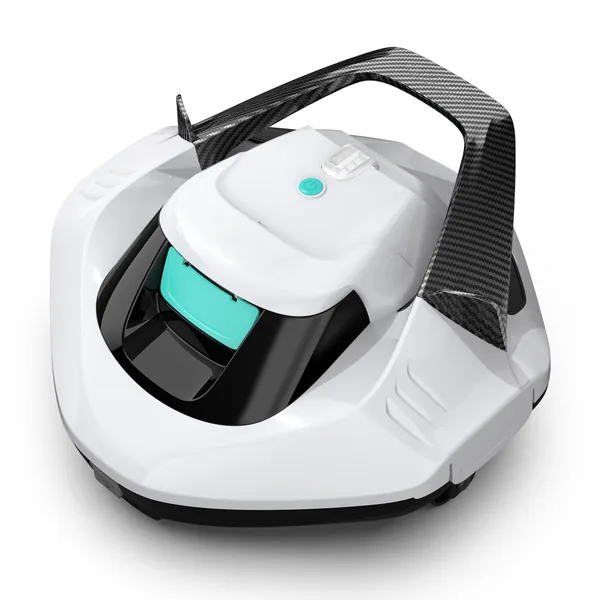
Robotic pool cleaners are self-contained electric units with their own motor, filter, and navigation system. They don't connect to your pool's plumbing and operate independently of your pool pump.
The 5 Systems Inside a Robot
Electric motors power tank-style tracks or wheels. Premium models have 4WD for better wall climbing and corner handling.
Rotating brushes scrub surfaces to dislodge algae and debris. Some models have counter-rotating dual brushes for extra cleaning power.
A dedicated pump creates suction to pull in debris through the filter. This is separate from your pool's main pump system.
Captures debris as small as 50 microns (much finer than standard pool filters). Can be cartridge or bag style.
Uses sensors and algorithms to map the pool and clean systematically. Advanced models use gyroscopes or AI for better coverage.
Navigation Types
| Type | How It Works | Best For |
|---|---|---|
| Random Bounce | Moves randomly, changes direction when hitting walls | Budget models |
| Gyroscope | Uses orientation sensors for systematic coverage | Mid-range models |
| LiDAR/AI | Scans pool shape and plans optimal path | Premium models |
Why It Doesn't Need Your Pump
Robotic cleaners have their own filtration system:
- Energy efficient: Uses 150-300W vs 1500W+ for pool pumps
- Better filtration: Captures particles as small as 50 microns
- Independent operation: Can run anytime, regardless of pump schedule
Corded vs Cordless: Key Differences
Most robots are corded for continuous power, but some newer models are cordless:
- Unlimited runtime
- More powerful suction
- Heavier due to transformer
- Potential cord tangling
- No cord to manage
- Limited runtime (2-3 hours)
- Lighter weight
- Less suction power
What Happens When a Robot Gets Stuck
Every robot gets stuck occasionally. The common scenarios and what's actually happening internally: a robot stuck in the deep end corner is usually a navigation algorithm issue - it's reached the boundary of its programmed coverage area and the wheels are spinning against a tile edge with no traction. Most robots will self-correct within 30-60 seconds by reversing and choosing a new path. If it keeps returning to the same stuck point, there's likely a surface irregularity (grout line, sharp tile edge) that the brush roller is catching on.
Robots stuck near the drain are a different issue: the suction is pulling the robot down onto the drain cover. This is why most quality robots have suction regulation - they sense when suction becomes too strong (indicating the inlet is blocked) and reduce pump speed before the robot becomes immobilized. Budget robots without this regulation will stick to drains regularly. It's a spec worth checking before buying.
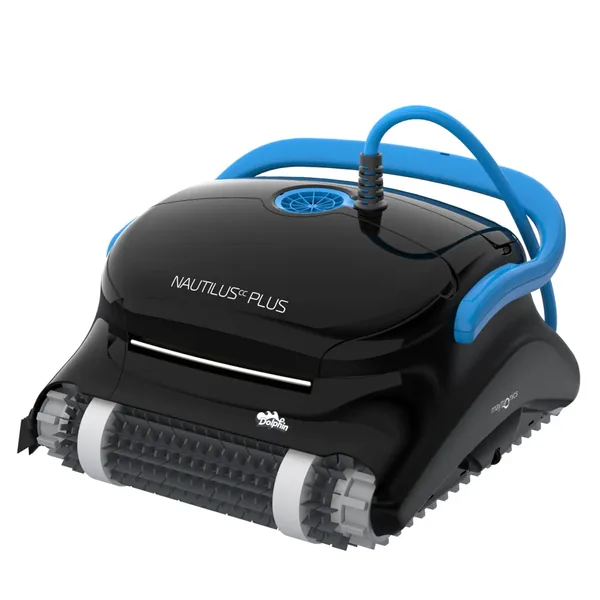
The cord tangle issue that bothers a lot of new robot owners: the power cord has a built-in swivel at the connection point that prevents twist buildup for about 40-50 navigation turns. After that, the robot needs to be lifted out, the cord unwound, and restarted. On premium robots like the Dolphin Nautilus CC Plus, the swivel cord design handles about 2-3 hours of cleaning before needing intervention. Cheaper robots without quality swivel cords tangle faster and more frustratingly.
The Filtration Advantage: Why Robot Filters Beat Pool Filters
Your pool's main filter - whether sand, cartridge, or DE - is typically rated to capture particles down to 20-100 microns, depending on type. Sand filters run 20-40 microns on a good day. Robot cartridge filters run 50-70 microns, but here's the key difference: the robot brings the filtration to the debris rather than waiting for water circulation to carry debris to a fixed filter location. Algae spores (10-50 microns) and fine silt that would take days to reach your pool filter through normal circulation are scooped up immediately during a robot cycle. This is why chemically balanced pools with a robot running every other day typically use 20-30% less chlorine than pools without one - algae spores get physically removed before they establish.
What Happens Inside the Robot: A Closer Look at the Suction System
Most pool owners understand that the robot has a motor and a filter, but the internal fluid dynamics are more interesting than they might expect - and understanding them explains why filter maintenance matters so much more than most product documentation suggests.
The robot's impeller (the spinning component that generates suction, equivalent to a small centrifugal pump) pulls water through an inlet port at the bottom or rear of the unit. That water stream carries debris up into the filter basket or cartridge, where particles are captured and clean water exits through the filter media and is expelled out of the top of the unit. The exit flow creates forward thrust that supplements the drive motors, particularly on premium models that are designed to use this thrust for propulsion efficiency.
Here's why the filter state matters mechanically: as the filter loads with debris, the pressure differential across the filter media increases. The impeller has to work harder to maintain the same flow rate, drawing more current and generating more heat in the motor housing. Most robots have thermal protection that reduces motor output if heat becomes excessive - which is why a heavily-clogged-filter robot slows down noticeably toward the end of a cycle on a dirty pool. It's not a malfunction; it's the thermal protection doing its job. Cleaning the filter returns the system to rated performance immediately on the next cycle.
The brushes add a mechanical dimension the suction alone couldn't achieve. On plaster surfaces with light algae, the brushes dislodge attached particles into suspension where the suction can capture them. Without brushes, the suction inlet would need to be much closer to the surface and the flow velocity much higher to achieve the same effect - which would require a significantly larger motor. The brush-plus-suction combination is why robots clean more thoroughly than suction-only vacuum heads at comparable motor wattage.