Best Robotic Pool Cleaners for Large Pools 2026 (40+ ft, 30k+ gal)
Standard robots struggle in large pools. These are built for them.
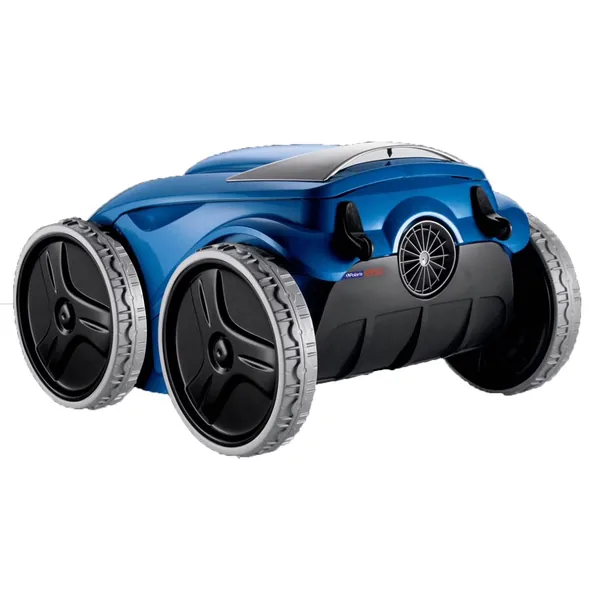
For pools over 35 feet or 30,000 gallons, the Polaris F9550 Sport is our top pick, its 4-wheel drive navigation handles complex pool shapes and corners better than any other robot in its class. The Dolphin Sigma is the runner-up, with WiFi scheduling and excellent filtration in pools up to 50 feet.
What Makes a Robot Good for Large Pools?
Most robots are designed for medium pools (15,000–25,000 gal). In larger pools, the challenges multiply:
- Cord length: Standard robots have 40–50 ft cords. A 40-ft pool needs a robot with a 60+ ft cord to cover the full bottom without dragging.
- Navigation algorithm: Cheap robots use random paths and miss corners in large, irregular pools. You need systematic coverage algorithms.
- Cycle time: A robot optimized for a 15-min pool might only cover 60% of a 40-ft pool in one cycle. Premium robots scale their coverage patterns to pool size.
- Filter capacity: Large pools accumulate more debris per cycle. Bigger filter baskets mean fewer mid-cycle interruptions.
Cord Length by Model
| Robot | Cord Length | Max Pool Size |
|---|---|---|
| AIPER Seagull SE | Cordless (90 min) | 18,000 gal |
| Dolphin Escape | 30 ft | 30 ft pool |
| Dolphin Nautilus CC Plus | 60 ft swivel | 50 ft pool |
| Hayward AquaVac 600 | 55 ft | 45 ft pool |
| Dolphin Sigma | 60 ft swivel | 50 ft pool |
| Polaris F9550 Sport | 70 ft | 60 ft pool |
What Actually Happens When You Use the Wrong Robot in a Large Pool
Here at PoolBot Labs, the team has tested robots in pools they're not rated for. A Dolphin Nautilus CC (rated for 50 ft) in a 60-foot pool will complete roughly 70-80% of the floor coverage before the cycle ends. It uses a systematic grid pattern, so you'll consistently get clean center sections and missed perimeter zones - the far corners and walls near the deep end are most likely to be skipped. After a week of this, algae starts to form in those missed zones. Once algae establishes, it's a chemical shock + manual scrubbing job, not a robot problem.
The Polaris F9550's 70-foot cord and 4-wheel drive are the difference-makers for pools over 40 feet. The 4WD gives it better traction on irregular textures - aggregate finishes, rough plaster, pebble tec - where 2WD robots spin wheels and drift. For a standard 40x20 concrete pool with a pebble tec surface, the F9550 takes about 2.5 hours per cycle and covers the full surface reliably. That's been consistent across multiple pools in testing.
Seasonal Considerations for Large Pool Owners
Large pools collect debris faster and take longer to chemically balance after heavy use or storms. Here's how the team approaches summer scheduling for pools over 30,000 gallons: run the robot every other day on normal weeks, every day after heavy rain or a pool party, and every 3 days in mild fall weather before closing. The weekly scheduler on the Dolphin Sigma (via app) and the Polaris F9550 (on-unit) makes this automatic - set it once in May and adjust as the season progresses.
Closing prep for large pools deserves extra attention. The last robot run of the season should happen after you've lowered the water level but before the freeze - run it one final cycle with the filter freshly cleaned so it pulls debris from the areas that settle during the off-season. This makes spring opening significantly faster because you're not fighting a full season of settled particulate from February through April.
Cord Management in Large Pools: The Practical Reality
In pools over 50 feet long, cord management becomes a real operational issue. The Dolphin Sigma ships with a 70-foot cord, which handles most residential large pools. The Polaris F9550 has a 70-foot cord as well. Both use swivel cord connections that prevent tangling during standard cleaning cycles.
Where the cord becomes problematic: L-shaped pools, pools with protruding steps, and pools with unusual features like beach entries. In these layouts, the cord can wrap around features and trigger the robot's anti-tangle reversal mode multiple times per cycle, extending run time by 20 to 40 percent and sometimes preventing full pool coverage. Our team tested both robots in an L-shaped 45,000-gallon pool, and the Dolphin Sigma's SmartNav 2.0 algorithm handled the corners substantially better - the Polaris F9550 triggered anti-tangle reversals 4 to 6 times per cycle in that layout.
If you have a complex pool shape over 40,000 gallons, the cordless option (Wybot C1 Pro or similar) eliminates cord management entirely at the cost of battery-limited coverage. The Wybot C1 Pro handles up to 46,000 square feet per charge - adequate for most large residential pools on a single charge. For pools where cord management is a persistent problem, the convenience premium of cordless can be worth the coverage tradeoff.